Start with What Happens When the Pump Stops
By Pioneer Valve · Published September 11, 2026
A check valve can pass the required flow and still behave poorly when a pump slows down or trips. Noise, disc movement at low flow and sudden closure all deserve attention before comparing prices. A swing check valve vs dual plate check valve decision should therefore consider the full operating cycle, including the lowest flow and the conditions immediately after shutdown.
A swing check valve uses a single hinged disc; a dual plate check valve uses two hinged plates, commonly with spring assistance. Both open under forward flow and close to oppose reverse flow. Their different moving elements and body arrangements affect the questions you need to ask about closing response, space and maintenance.
Review the swing check valve and dual plate check valve product pages once the operating requirements are clear. Neither design should be selected by nominal pipe size alone.
Swing vs Dual Plate: Selection Comparison
| Selection point | Swing check | Dual plate check |
|---|---|---|
| Moving elements | A single disc swings about a hinge; closure assistance varies by design. | Two plates pivot on a central hinge arrangement, commonly assisted by springs. |
| Body and space | Conventional flanged bodies often have a longer face-to-face dimension. | Compact wafer configurations can reduce the required installation length. |
| Low-flow review | Check the flow needed for stable disc opening. | Check the flow needed to open and stabilize the plates against spring load. |
| Pump-trip review | Disc travel and system deceleration affect closure. | Plate travel and spring response affect closure; system conditions still matter. |
| Maintenance | A cover may permit access to internal parts after safe isolation. | Access may require removal from the line; confirm the actual design. |
For an example of the mechanism, CRANE's Duo-Chek description documents a compact dual-plate design with independent springs. Its features and performance claims belong to that product family, not to every dual plate valve.
Closing Response Matters More Than a Non-Slam Label
Check valve slam can occur when appreciable reverse flow develops before the moving element closes. Stopping that reverse flow can produce a pressure surge. How quickly forward flow decelerates and how the valve responds must therefore be considered together.
A shorter moving stroke or spring-assisted closure may improve response in a suitable application. It does not establish that a valve will eliminate water hammer in an unknown pipeline. Val-Matic's engineering manual explains the relationship between system deceleration and check valve dynamic behavior.
For a line with a history of banging or pressure spikes, provide the pump trip sequence, pipe arrangement and available pressure recordings. Ask whether dynamic valve data and a system transient analysis are needed. Replacing one valve type with another without understanding the shutdown event can leave the underlying issue unresolved.
Compare the Whole Flow Range
Minimum flow and stable opening
A large valve is not automatically a better valve. If operating flow is too low to hold its disc or plates stably open, movement and wear can become concerns. Ask the supplier for the minimum stable operating flow or velocity for the offered configuration, not just the pressure required to begin opening it.
Pressure drop at normal duty
Compare pressure-loss curves at the flow where the system spends most of its operating hours. Check that the curves apply to the proposed size, spring and internal construction. A fully open curve alone may not describe performance at a low operating flow.
Maximum flow and shutdown
Supply the maximum flow and the conditions during a trip or change in pump operation. Keep steady-flow loss and dynamic closing behavior as separate checks. A low pressure drop does not, by itself, prove acceptable shutdown performance.
Space, Orientation and Maintenance Access
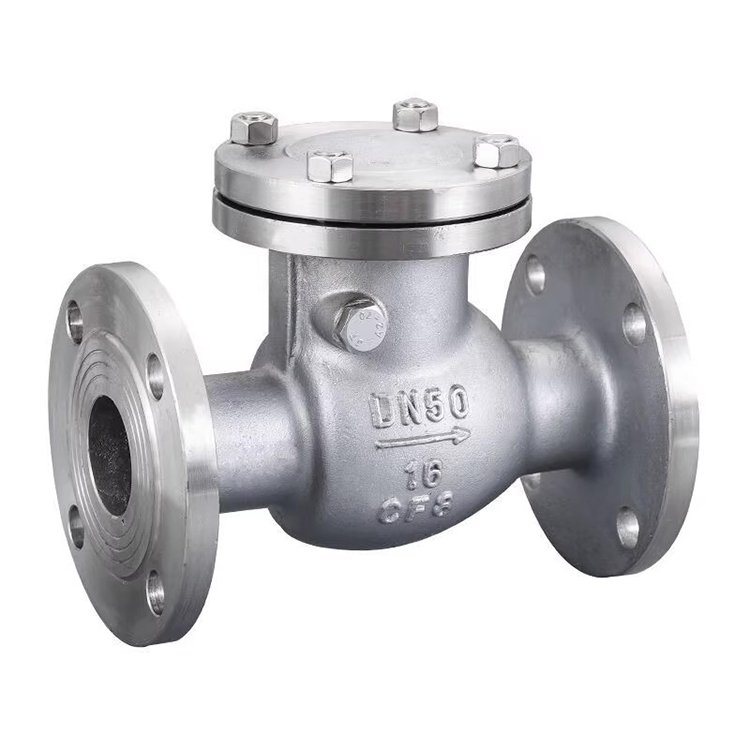
A conventional flanged swing check may provide cover access while remaining connected to the pipework. A compact dual plate wafer valve can save installation length, but servicing may require removing it from between the flanges. Compare actual drawings and the available lifting and dismantling space.
Confirm the allowed flow direction and installation orientation with the manufacturer. Nearby pumps, elbows and other fittings may affect flow distribution; request the required installation arrangement rather than applying a universal spacing rule. Inspection or disassembly requires the line to be isolated, depressurized and made safe under the site's procedure.
For connection details, see the wafer check valve guide. Wafer describes the body arrangement and should not be used as an exact synonym for dual plate.
Match the Medium and the Procurement Scope
Identify fluid composition, temperature, solids and any deposits that may form. Springs, hinges and sealing surfaces need materials appropriate to the service. Do not assume a dual plate valve is suitable for fibrous or abrasive fluid simply because its body is compact, or that every swing check can pass solids without difficulty.
Define the required pressure-temperature rating and reverse leakage acceptance for the selected configuration. Request the governing test standard, test conditions and documentation. A check valve's backflow function should not be treated as a substitute for a specified maintenance isolation arrangement.
If both options meet the hydraulic and mechanical requirements, compare the complete purchase: valve, piping changes, supports, spare parts and inspection scope. For broader alternatives, use our check valve selection guide before narrowing the specification.
Send These Details with Your Inquiry
- Minimum, normal and maximum flow, plus fluid composition and temperature.
- Operating and design pressure, reverse differential and leakage acceptance.
- Pump start, stop and trip conditions, including any surge history.
- Pipe size, orientation, flange standard and available face-to-face length.
- Required materials, documents, quantity and maintenance access.
For replacement projects, include the existing valve drawing and the reason for replacement. Leakage, recurring disc noise and lack of maintenance access point to different selection questions. A clear description helps avoid quoting a mechanically compatible valve that repeats the original operating problem.
Frequently Asked Questions
Does a dual plate check valve eliminate water hammer?
Not in every system. Spring assistance and shorter plate travel can improve closing response, but the resulting surge also depends on flow deceleration and reverse velocity at closure. Ask for dynamic data for the proposed valve. Where pump trips or pressure surges are significant, a system transient assessment is more useful than relying on a non-slam label.
Which design has lower pressure loss?
There is no reliable answer from the design name alone. Compare the supplier's pressure-loss curve for the actual size and configuration across your minimum, normal and maximum flow. A valve that is not sufficiently open can behave differently from a fully open test condition. Include annual operating hours if energy cost is important to the purchase decision.
Can either valve be installed vertically?
Only where the offered model's installation instructions permit the required orientation and flow direction. Vertical upward and downward flow are different duties, and spring presence alone does not confirm suitability. Identify the pipe orientation and nearby fittings in the inquiry. Request the required hinge or shaft orientation and any restrictions before finalizing the piping arrangement and installation procedure.
Is a wafer check valve always a dual plate valve?
No. Wafer describes a compact body connection installed between flanges, while dual plate describes the moving closure elements. Wafer check valves can use different internal arrangements. State both the required connection and closure design when requesting a quotation, and verify the offered drawing rather than assuming the words wafer and dual plate identify the same product.
Can a dual plate valve replace a flanged swing check valve directly?
Usually the replacement needs a dimensional review rather than a same-size substitution. Check face-to-face length, flange compatibility, pipe supports and clearance for the moving plates. A shorter body may require piping changes. Also review flow stability and closing behavior, because matching the nominal size and pressure class does not establish equivalent operation during normal flow or a pump trip.
What information helps select a check valve for a variable-speed pump?
Provide the minimum, normal and maximum flow, operating pressure, fluid properties and pump control sequence. Include start and stop frequency, expected trip conditions and any measured noise or pressure spikes. Ask the supplier to confirm stable opening across that range. A valve selected only for maximum flow may spend much of its operating life partly open.
Final Thoughts
Choose between swing and dual plate check valves by the operating flow range, closing response and installation requirements. Review pressure loss and pump-trip behavior separately, then compare maintenance access and quotation scope. Pioneer Valve can discuss these requirements against its check valve range. Send the service data, piping arrangement and any shutdown observations so the proposed configuration addresses the actual application.
Discuss Your Check Valve Duty