Protect the Pump Through the Whole Stop Sequence
By Pioneer Valve · Published September 11, 2026
A pump discharge check valve may look satisfactory at design flow yet chatter at reduced output or close too late after a trip. Those conditions can shorten component life and intensify pressure transients. Selection should begin with the pump's complete operating range and shutdown sequence, then balance stable opening, closing response, pressure loss, installation limits and maintainability.
The right check valve for pump discharge is the valve that remains stable across the expected flow range and closes appropriately for the system's rate of flow reversal. Nominal pipe size, pressure class and a “non-slam” label are not enough to establish that performance.
Start with minimum, normal and maximum flow. Then document pump inertia, speed-control logic, start and stop frequency, discharge pressure, pipeline profile and any existing noise or surge. This separates routine reverse-flow prevention from a system that needs a more detailed transient assessment.
What the Valve Must Do at Pump Discharge
During forward flow, the closure element must reach a stable position without repeated movement. When the pump slows or stops, the valve must respond as flow approaches reversal. The pressure rise created during this event depends on the system and the valve's dynamic response, not simply whether the valve eventually reaches its seat.
Three separate checks
Hydraulic: verify opening behavior and pressure loss throughout the real flow range. Dynamic: examine how quickly reverse velocity develops and how the proposed valve closes. Mechanical: confirm orientation, connections, materials, access and maintenance requirements.
Cracking pressure is only the differential needed to begin opening. It does not prove that the disc or plates will reach and hold a stable operating position at the lowest sustained flow. Request the manufacturer's flow or pressure-loss data for the actual size and internal configuration.
Compare Check Valve Designs for the Duty
| Design | Why it may be considered | Questions to resolve |
|---|---|---|
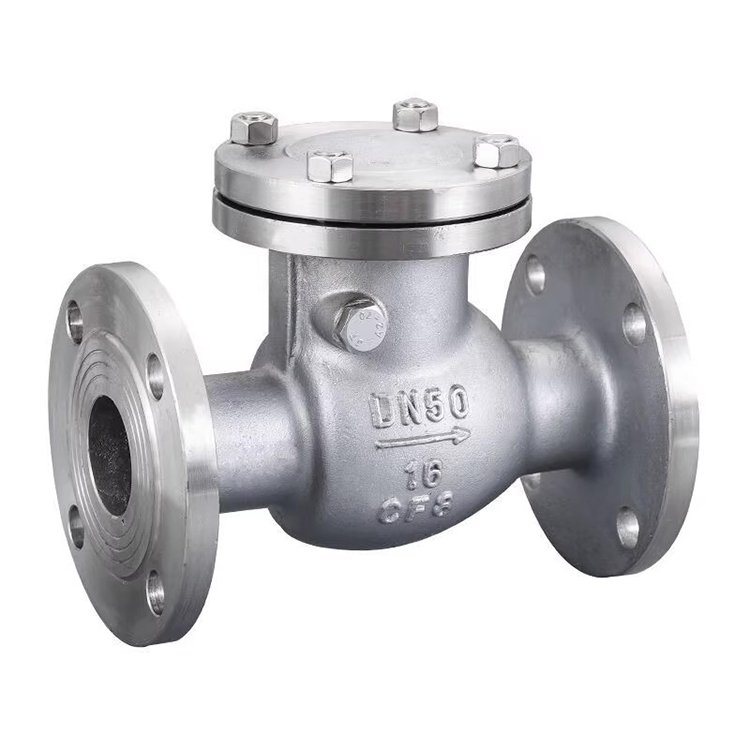
| Swing check valve | Simple hinged-disc arrangement and a familiar flanged configuration for steady industrial flow. | Disc stability at low flow, available installation space, closing response after a pump trip and maintenance access. |
| Dual plate check valve | Compact body and shorter plate travel; many configurations use spring assistance. | Actual pressure-loss curve, spring and plate behavior, orientation limits, flange compatibility and dynamic data for the offered size. |
| Lift check valve | Guided closure can be useful where the specified service and installation match the design. | Required differential, pressure loss, horizontal or vertical suitability, clean-flow needs and access to internal parts. |
| High-pressure check valve | Appropriate construction can address higher design pressure and reverse differential. | Pressure class alone does not settle closing dynamics; verify body, trim, leakage, testing and pump-trip requirements together. |
This table is a screening tool, not a ranking. The same design family can perform differently as size, spring, disc mass, travel and internal geometry change. Compare the supplier's data for the proposed configuration rather than transferring assumptions from another model.
Size for the Flow Range, Not the Line Label
An oversized check valve may not open fully at reduced flow. The closure element can hover or move repeatedly, creating noise, local wear and uncertain closing behavior. A valve chosen only from maximum flow can therefore be a poor fit for a variable-speed pump or a duty/standby system that spends long periods below its design point.
For each candidate size, compare pressure loss at minimum, normal and maximum flow and ask whether the valve reaches a stable-open position. If a smaller valve is considered, include reducer geometry, velocity limits and piping loads in the engineering review. The objective is not simply the lowest pressure drop; it is predictable operation without imposing unacceptable energy cost.
Pump Trips, Valve Slam and Water Hammer
Valve slam occurs when meaningful reverse flow develops before the closure element reaches its seat. The sudden interruption of that reverse velocity can contribute to a pressure transient. A quick-closing construction may reduce reverse travel in a particular system, but no valve name by itself guarantees that water hammer will disappear. Our guide to check valve water hammer explains the shutdown sequence, diagnostic evidence and mitigation options in detail.
The Val-Matic check valve engineering manual relates slam potential to system flow deceleration and valve dynamic characteristics. This is why a valve that behaves well in one station may respond differently in another pipeline with a different length, elevation profile, fluid velocity or pump inertia.
Use a transient analysis when the consequence or likelihood of surge is significant: long transmission mains, fast pump trips, multiple pumps changing state, high velocities, previous slam or unexplained pressure spikes. Give the analyst the proposed valve's dynamic data rather than substituting a marketing category for an operating curve.
Installation and Parallel-Pump Details
The selected manufacturer's instructions should control orientation and required straight piping. Shaft or hinge position, upward or downward flow and proximity to elbows or reducers can influence operation. Check that the body fits between flanges, the closure element clears the bore and technicians can remove covers or internal parts without dismantling excessive piping.
In a parallel station, identify every pump combination: one running, several running, one stopping while others continue, and emergency trip. A check valve on each discharge branch is commonly used to limit backflow through an idle pump, while a separate isolation valve supports maintenance. Do not use the check valve as proof of positive isolation.
Also review the valve's location relative to the pump and control valve. There is no universal straight-run number that fits every design. Supply the piping arrangement to the valve manufacturer and follow the installation instructions for the offered model.
Pump Discharge Selection Workflow
- Define the liquid and duty. Record composition, solids, temperature, vapor concerns and corrosion or erosion requirements.
- Map the operating envelope. Include minimum, normal and maximum flow, pressure and every planned pump combination.
- Describe shutdown. Provide normal ramp-down, emergency trip, pump inertia, control logic and any surge history.
- Screen suitable designs. Compare stable opening, pressure loss, closing response, orientation and maintainability.
- Verify the offered configuration. Review the drawing, materials, flange standard, face-to-face, leakage requirement and test documents.
- Escalate dynamic risk. Use transient analysis where the system or consequences justify it.
If you are comparing only two common arrangements, the guide to swing check valve vs dual plate check valve develops the mechanical and operating differences in more detail. For a broader screen, see how to choose a check valve.
Send These Details with Your Inquiry
With these inputs, Pioneer Valve can discuss which available check valve configuration should move into detailed technical review. Final selection should be confirmed against the offered drawing, data and the complete piping system.
Frequently Asked Questions
Which check valve is best for a pump discharge?
There is no single best design for every pump. A swing check valve may suit stable, continuous service where space and closing behavior are acceptable. A spring-assisted dual plate or other faster-closing design may be considered where reversal develops quickly. Compare the actual valve at minimum, normal and maximum flow, then review the pump-stop transient before selecting.
Should the discharge check valve match the pipe size?
Not automatically. Matching the nominal pipe size can leave an oversized valve partly open at normal or minimum flow, which may promote unstable movement and wear. Size the valve from the operating flow range and the manufacturer's flow data, while checking acceptable pressure loss and connecting dimensions. Any reduced valve size also requires a properly engineered piping transition.
Can a non-slam check valve prevent water hammer?
The label alone cannot guarantee that result. Closure response, flow deceleration, reverse velocity, valve travel, pipeline length and pump inertia all influence a surge event. Ask for dynamic characteristics for the proposed size and configuration. If the system has rapid trips, long pipelines or a history of pressure spikes, include a transient analysis rather than relying only on a product description.
Where should a check valve be installed after a pump?
Place it where the pump and piping design allow stable approach flow, correct orientation, inspection and removal. Nearby elbows, reducers and control devices can affect the local velocity profile, so follow the selected manufacturer's installation instructions rather than applying one universal distance. Confirm flow direction, shaft or hinge orientation, supports and access before issuing the final piping layout.
Does each pump need a check valve in a parallel pumping system?
A discharge check valve is commonly used on each parallel pump branch to limit backflow through an idle or stopped pump. Its suitability still depends on the control sequence, shared-header pressure and expected reverse differential. Provide the number of pumps and operating combinations during selection. Separate isolation valves are normally required for maintenance; a check valve should not be treated as positive isolation.
What data should I send when requesting a pump discharge check valve?
Send the fluid, temperature, minimum, normal and maximum flow, suction and discharge pressures, design pressure and pipe size. Add pump type, speed control, start-stop frequency, trip behavior, line orientation, flange standard and available face-to-face space. Note any slam, vibration or measured surge history. These details support a more useful technical review than size and pressure class alone.
Final Thoughts
Compare spring-assisted closure, flow sizing and purchasing requirements on our silent check valve page. Provide the operating flow range and pump shutdown conditions when requesting a configuration review.
A dependable pump discharge check valve is selected from operating flow, shutdown dynamics and installation reality, not from pipe size alone. Verify stable opening and pressure loss first, then examine closure behavior and surge risk. Pioneer Valve can review its available check valve configurations against your duty. Send the pump data, piping layout and operating history so the discussion starts with the actual system.
Discuss Your Pump Discharge Duty